
Barry Bernstein: Comparing WEC and GMP Bills
I’ve been an active member of the Co-op for more than 50 years, and as a director and President of WEC’s Board of Directors for over 20 years. One of the questions I still get asked is why are WEC’s residential electric bills higher than Green Mountain Power’s, the investor-owned utility that serves the more densely settled parts of central Vermont.
There are several things about this comparison that are important to know, and that I still find members do not realize.
First, WEC came into existence because our members’ territory was not profitable for an investor-owned utility like GMP to serve. Our members live in a very rural and highly residential (95%) territory that is geographically and economically expensive to serve due to low population density (8 members/mile/ave), with fewer commercial/industrial businesses and an average 475 kWh/mo usage per residential member. While there have been many changes in our area of Vermont over the last eight decades, it still remains among the most rural and most challenging places in the northeast in which to provide electricity.
Second, WEC is a not-for-profit organization. WEC returns to its members the revenue it collects above what it needs to pay for power and operating expenses. WEC has been in business since 1939 and since 1998 has returned more than $10. 8 million as “capital credit[s]” patronage refunds to current and former members. You will see that credit on your November bills every year. During that same time frame WEC’s rate increases totaled $9.4 million, averaging less than the annual cost of inflation. Just to be clear, not an apples to apples comparison as rate increase dollars are embedded in rates.
Third, I also challenge the underlying assumption that some members seem to hold that it is significantly cheaper for residential electric users to be served by GMP.
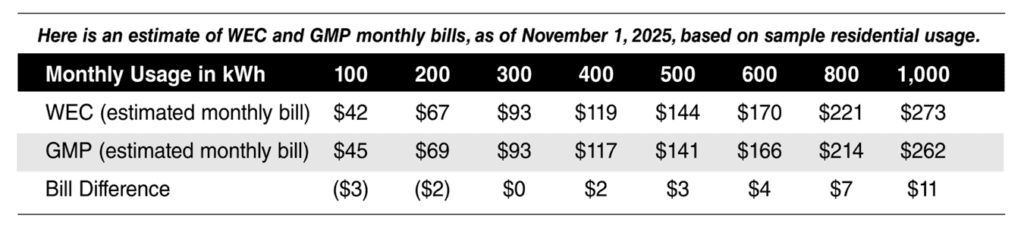
WEC and GMP have very different rate structures. However when you compare what you pay for your monthly bill, as you can see in the chart below, there is very little difference for 80% of our members. For our low to moderate users (300 kWh/mo or less), 50% have monthly electric bills that are less than GMP customers.This does not take into account the Capital Credit on your November bills.
Here is an estimate of WEC and GMP monthly bills, as of November 1, 2025, based on sample residential usage.
It is also important to note that on average, WEC members use significantly less electricity in a typical month than GMP residential customers. This is due at least in part to WEC’s long-standing efforts to encourage members to use electricity efficiently and with care, including through our lower rate for the first “100 KWH block” of power used.
Finally, and perhaps most importantly, is the fact that WEC has been and remains one of only three utilities in Vermont that has and continues to provide our members with 100 percent renewable power.
While both GMP and WEC supported the recent Renewable Energy Standard bill, which requires GMP to become 100 percent renewable by 2030, as of right now, although they are 100 percent carbon free, nuclear power still makes up 30 percent of GMP supply.
It’s fair to compare the cost of power from different utilities, and WEC members’ opinions matter a tremendous amount as they are not only the ratepayers but also the owners. However, it is also important to consider the full context of electricity costs and benefits when making these comparisons.
Barry Bernstein
East Calais
Monique Hayden: Backup Solar Installation Experience
We recently installed a solar backup system for our home in Williamstown. We’re served by the Jackson Corners substation and were initially told that solar wasn’t an option due to capacity limitations of this particular substation. This turned out to apply only if we wanted to put our excess solar back into the WEC distribution system as a net-meter project. We were not deterred. We still wanted some type of backup in an outage and still saw opportunities for reducing our grid consumption as a side benefit, even without net metering. And it turns out we may still be able to net meter in the future, depending on what happens with the substation.
Why solar? Our house was originally designed and sited for passive solar, and we later installed solar hot water, so additional solar just seemed to make sense. With WEC already 100% green (yay!) a backup system using fossil fuels felt like a step backward.
We’ve learned quite a bit in this process. Clearly, we didn’t know what we didn’t know. Our top solar production is less than we thought it would be, but not different than what was quoted, making us glad we decided to add 2 more panels beyond the original design.
Our goals were modest and simple: first, to provide limited backup to ease the inconvenience of outages; and second, to replace some of the increased grid consumption from our electric cars. We’ve had mixed success with this plan.
Our wood heat (no fan or blower) and propane cook stove allow us to easily be warm and fed during a grid outage. We are not so lucky with water for toilets and bathing, or food refrigeration; this we planned to address with solar. We sized the system with the understanding we would need to limit and manage our energy consumption in a fashion similar to rolling blackouts, only self imposed. We would use the stored battery power from the solar only for short bursts in the morning and evening, for hygiene and refrigeration. For much of the daytime and overnight hours we would elect to go without powered conveniences. Ideally, the next day would bring enough sun to regenerate the battery level to allow us to repeat the on/off cycles as needed, for multiple days.
We’ve had our tiny solar system running now since August 2025. It was exciting to see the solar generation reduce our grid consumption. Our usage patterns became evident almost immediately, as did the things that draw the most power. We experienced a few brief outages as part of the fine-tuning, seamlessly switching from grid to battery consumption. Additionally, we ran 20-hour outage simulation. These seamless transitions seemed amazing at first. But then we wondered, how can we manage our usage in an outage if we don’t know the grid is out?
We decided the easiest way to know when the grid was out was to actually experience the outage, then we could decide how we wanted to manage our usage until the outage was resolved. Eliminating the seamless transition proved to be more challenging than we ever expected, a comical request, even, as seen by the manufacturer.
Our lives are all now so dependent on constant power that this manual option is not built into the equipment, was not conceived as part of the initial design and, it seems, it cannot be reverse engineered. It appears unless we are in constant contact with a cell phone (an unappealing option at best) there is no way for us to easily know when the source of our power has been switched to the battery. There are a few things we can do to safeguard drawing the battery down too far too fast but these solutions are far from ideal.
This rigid aspect of the system is a great disappointment to us, and our disappointment is a great surprise to the manufacturer. Why would anyone want to be out of power for even a second? When the grid power fails for whatever reason, you can usually hear the hum of the house change or you see some of your digital clocks begin to flash. Even a brief delay (to perhaps trigger some flashing) would work better for our particular needs than this amazing seamless and, with solar, silent switch.
It’s unfortunate we didn’t think to ask this question early in the process and difficult to know how the outcome might have been different. Despite this feature-limitation complicating our intended use, overall, we think solar will be a positive part of our outage preparation and energy use going forward.
We will likely always keep battery-operated lights and extra utility water on hand for extended outages, out of habit and caution. And also now because of the unavoidable delay in becoming aware of switching to battery use. In a best-case scenario, however, we’ll most likely have some extra stored energy to tap into so we can more easily tend to basic hygiene and be less concerned for food losses from extended grid outages.
Monique Hayden – Williamstown