
Good Planning Helps Insulate WEC Bills from Sector-Wide Rising Costs
By Brian Callnan
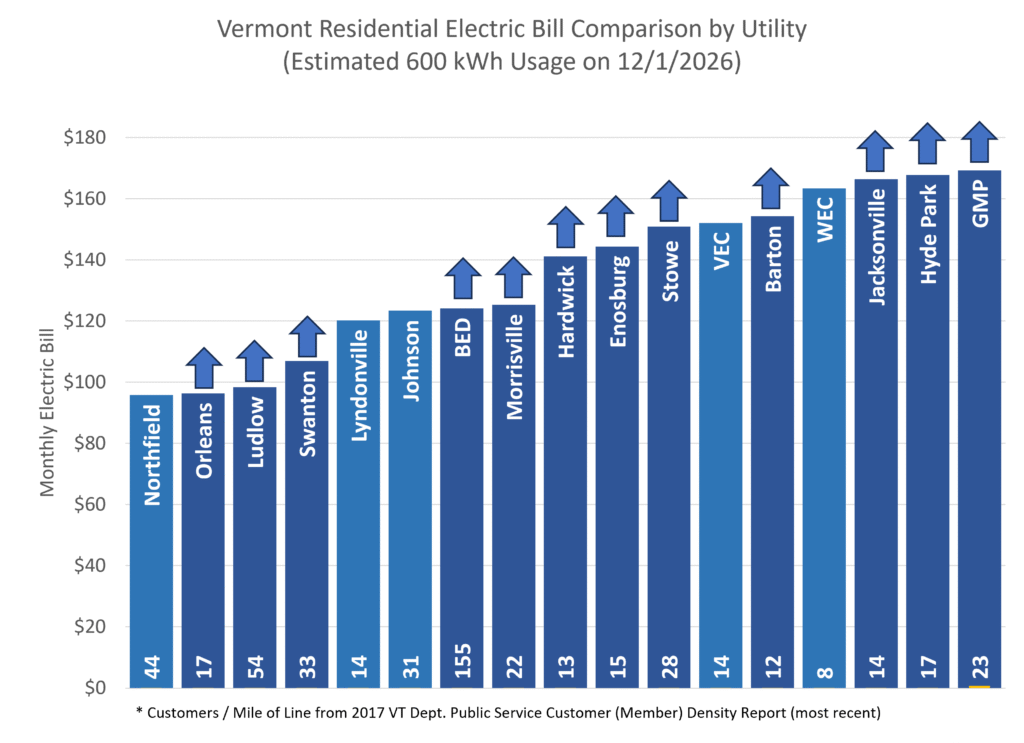
2026 has been an active year for utilities requesting rate increases. Through September, nine of Vermont’s 17 distribution utilities have implemented rate increases. But WEC has kept your rates flat since January of 2025, when an increase of 2.9% was implemented. We’ve been able to do this even though WEC’s service territory is so challenging.
There are lots of reasons customers of neighbor utilities are seeing their electric bills rise, but increasing profit is not one of them. All but one of Vermont’s utilities are either not-for-profit cooperatives or nonprofit municipalities. Green Mountain Power (GMP), Vermont’s only investor-owned utility, has formulaic rates that are adjusted every year by the Public Utility Commission. In October 2026, GMP was granted a Return on Equity (ROE), or profit to shareholders, of 9.05% versus 9.97% in Fiscal Year 2026. This means the rate of “profit” for GMP was actually reduced about 1%.
Lower Member Density, Higher Rate Pressure
WEC’s distribution system is in some of the most beautiful parts of the state, but those beautiful parts are on back roads, open fields, and sugarbushes. Our rural character makes maintaining our distribution lines difficult. Our miles of line could stretch from here to Georgia, but we have less than 10 members per mile to help support that infrastructure — the lowest service density in the state.
There’s a saying we have that if you’re driving around Central Vermont on a dirt road, then the electric line you see is probably a WEC line. If you’re on pavement, it’s probably another utility’s. This makes sense because back in the 1930s, for-profit utilities decided that bringing power to WEC’s rural farms wasn’t worth the investment, so WEC’s founders formed our rural electric cooperative to meet their needs. This reality means that relative to other utilities, WEC will continue to have fewer members covering increasing costs to maintain our lines — which puts constant pressure on our rates.
Why Are Other Utility Bills Rising?
So, what’s driving other utilities’ rate increases? To find the answer, we took a look at some of their rate increase requests to the Public Utility Commission.
In GMP’s case, their filing cites increasing transmission costs, investment in their Zero Outage Initiative (ZOI), investment in energy storage systems for their customers, taxes, depreciation, and yes, more profit. Even though their ROE was reduced to 9.05%, it was multiplied by a significant amount of equity investment in their ZOI resulting in higher expected profit for 2027 than in 2025.
Hyde Park’s increases were different from GMP’s. They requested two different rate increases during the year to catch up to costs from previous years. Some of the reasons cited were past investment in a solar project that’s large compared to their electric needs, not historically raising rates enough to cover operating losses, and significantly increased transmission costs. Jacksonville also reported that a rate increase was needed to cover past operating losses. Most of the other utilities cited increased power supply costs and transmission costs as main components of the need for rate increases.
Good Planning Keeps WEC’s Rates Stable
How has WEC managed to avoid a rate increase in 2026? One of the reasons we’ve been able to keep our rates stable for the better part of two years is our Coventry landfill gas-to-electricity plant. We use this plant to reduce the amount of power we need to purchase. This helps us avoid many of the increasing costs that the rest of Vermont’s utilities have cited as the reason for rate increases. In 2025, the Coventry plant provided almost 60% of the power we used. We get another 10% of load reduction from member net metering installations (See my article The Duck Curve, August-September 2026, for how solar net metering has shifted peak energy times). That leaves us with roughly 30% that we need to purchase elsewhere. The remaining 30% is also met with renewable resources, as WEC is a 100% renewable utility. Because WEC and our members self-generate around 70% of our energy, we are insulated from many of those increasing costs we see in the market.
How We’re Planning For The Future
WEC has and will continue to benefit from its decision to enter into long-term contracts to meet its members’ needs for energy. Some of those contracts will start to expire in five years. We’ll be looking into either extending them or replacing them with something similar so we can continue to minimize our exposure to increasing market costs. We’re also looking to use battery storage technology at the member and the utility level. These flexible resources can help WEC reduce increasing capacity and transmission costs. More to come on that front in a future Co-op Currents.
Brian Callnan is WEC’s Director of Power Supply and Regulatory Affairs.